Defensibility Through Giving a Shit
The New Indie Hacker Playbook


Every indie maker, every creator I know is exhausted. Burned out, depressed, and slowly losing either their shit or their minds. They’re paralyzed by fear, doubt, and a growing sense of futility.
And who wouldn’t be?
Scroll through Twitter, and the doomposting is impossible to ignore. We have less than 12 months to escape the permanent underclass! Indie making is over! There’s no future, there’s no point, and there’s no longer a path to wealth.
The basic belief boils down to this: AI means there is no moat. Whatever you build can be copied - by anyone - within 30 minutes. Corgi can clone Papermark almost pixel-for-pixel and, aside from online backlash, face little to no consequences. What’s stopping any other indie hacker from copying your own work, passing it off as theirs, and stealing every single customer you’ve worked your ass off to acquire?
And even if they don’t - what’s stopping big tech from doing the same thing? What’s stopping Google or Apple from making your product obsolete at their next keynote? Or worse - a foundation model releasing your tool’s entire functionality as a free feature overnight? Didn’t Claude Design essentially kill Lovable’s entire business model?
Even assuming you avoid having your product stolen by a competitor, surely your customers won’t want to pay $20 a month for your SaaS tool, now that they can vibecode their own using the single $20 subscription they already pay OpenAI?
Again and again, you find yourself asking - what’s the fucking point?
The assumption is that the game is over. There are no moves left, no plays to make. The final score is set. There’s no point trying to kick a goal when the match has been called. But I think that assumption is entirely wrong. The game is still in play - and the game will always be in play - and the rules changing doesn’t invalidate your participation. There is still a prize to be won.
Code is no longer the moat. It’s no longer a moat at all - not for you, and not for anyone else. But that doesn’t have to be the death of your indie dreams. In fact, for a solo-builder, it might be the best thing that’s ever happened...
Big Tech Doesn’t Care About You
Yes, there’s always a chance your product will be made obsolete as a side effect. But that’s only a threat if your entire product is actually a feature in the first place - if you’ve confused a utility for a sustainable business. A feature solves a single, isolated problem: it’s a basic screen dimmer, a simple to-do widget, a thin UI wrapper sitting on top of someone else’s API, etc. It has no depth, and it incurs no switching costs for the user. It’s a single-use tool.
But if a trillion-dollar company can replicate your core offering with a small pod of engineers and ship it as a minor software update, you were never building a company in the first place - and you were always on the edge of a knife.
An actual product // platform is an entirely different beast. It embeds itself deeply within complex user workflows, integrates with other essential tools, establishes a system of record, leverages proprietary data, and creates an identity or a collaborative community. Products handle the messy, complicated edge cases that generalized platforms will never bother to address.
If you’re afraid of being “Sherlocked,” it’s actually a litmus test for both your product-market fit and your confidence in your own work. If a single platform update can wipe you out, your offering was always temporary and fragile. Yes, a native OS update might siphon off your casual and free-tier users who only needed a basic fix to begin with, but your core, paying customers will stay because they rely on the specialized depth that a built-in feature will never provide.
But more than that - Big Tech doesn’t give a shit about you or your users. Google, Microsoft, Anthropic, OpenAI, Apple - they do not and will not care about specific use-cases. They’re playing a game of astronomical scale and chasing billion-dollar markets because they have no other choice. The economics they’re playing in need a staggering amount of capital. Between securing tens of thousands of GPUs, paying engineering and research talent, and covering the sheer build, operational, and energy costs of massive data centers, their overhead is near unprecedented - never has so much been spent by so few.
At that scale, Big Tech literally can’t afford to care about a highly specific, boring-as-all-hell B2B workflow that generates 5-6 figures a month in revenue. For a solo founder, a highly profitable, seven-figure ARR business is a life-changing success. For a behemoth, it’s not even a rounding error - it wouldn’t cover the power bill for a single server farm.
If you build a generic “chat with PDF” tool or a basic email summariser, you are going to get crushed; these are generalized utilities, and they will be bundled natively by a giant co. But if you build an inventory and routing tool specifically designed for HVAC dispatchers (etc., etc.), you’re 100x safer. To win in that space, you have to grok the messy and shitty nuances of specialized part SKUs, integrate or migrate from incredibly outdated legacy software, and solve the unique frictions of an extremely specific function. The tech giants will never look at you. They don’t have the time, the mandate, or the incentive to untangle the problems of your niche. If you can narrow your focus, you can build a profitable business completely outside Big Tech’s blast radius.
The Copycat Problem Isn’t Real
Any indie hacker can prompt together a near-exact replica of your app in a weekend. A good one can do it in an hour, and that process will only get better and faster. I could scrape your landing page, rip your UI, and reverse-engineer your entire feature list in the time it took me to write this post.
But cloning was always possible - it was simply an effort problem. It came down to whether or not someone had the appetite to bother creating a direct copy // competitor to whatever you built. There’s a reason the internet was lousy with To Do apps long before vibe coding became a thing. The ease of Claude Code and Codex scales the problem, but it didn’t invent it; and the “final mile” obstacle of actually turning a vibecoded output into an app with auth + payments remains a filter for the vast majority of would-be copycats who will simply lose interest when friction appears. Add to that - the more folks hand off their ability to write and create to AI, the less friction they’ll be able to absorb, and the safer builders who can actually ship will be.
I’m not sure the doomers actually understand software as a product. An app is not actually a static artifact - it’s a living, breathing system, shaped by a continuous feedback loop between a builder and his users; but a clone is a snapshot of a moment in time. When a copycat rips off an app, they can only steal its surface-level features. They can’t copy the context, the why behind each specific feature; they don’t know the series of agonizing tradeoffs and decisions and tests that went into getting the onboarding flow just right; and they don’t have the DMs, the support tickets, or the initial customer conversations with your first 5, 10, 100 users that informed your original roadmap.
Without that layer, the copycat is attempting to land a plane in real-time by looking at a photo of you on the tarmac. If the market shifts, if an API changes, if users want a different workflow, they don’t know how to pivot. They never actually understood either the customer or their pain in the first place. They might be able to play a game of imitation; you’re playing a game of iteration, and only one of those has a payoff worth anything.
New Moats?
That’s my case against doom.
Is there a case for optimism?
In my honest opinion, yes.
If AI can write a Python script in a matter of seconds, code as a moat is functionally dead. But that doesn’t necessarily mean there are hordes of Barbarians about to scale the walls and break down the gates, nor does it mean conquest and defeat are foregone conclusions. It just means you can’t count on technical complexity to keep them out.
There are moats beyond code, and for solo builders, I think the value is accumulating around intangibles - the parts of any product and any company that are deeply, uniquely human.
Moat 1: Community (Moat of Belonging)
Relationships are non-fungible. A relationship a user has to you and to their fellow users is impossible to steal or clone, and it can’t be faked. If your tool is a sterile utility, the second a competitor offers to save $5 a month, your users will jump ship. But if your product is a campfire where folks actually gather to talk, share stories and tips, and connect with others who look, talk, and think like them, leaving your product means leaving a tribe; and access to a community is an incredibly high switching cost. With loneliness steadily growing across the board, don’t discount how powerful connecting people can be as a moat; it can beat out any feature.
But a community is also a cheat code for the iteration game itself. Your community of power users is going to tell you exactly what’s broken, what’s missing, and what you need to build next. The clone factory can go right ahead and guess in the dark, but your tribe will show you every step. And as much as a vibecoder can spin up a boilerplate app with a UI straight from Mobbin, they can’t conjure up an active Discourse forum.
Moat 2: Identity (Moat of You)
It’s a cliche to say that people don’t buy products, they buy stories. But a cliche doesn’t mean it’s not true. Identity is a powerful immune response - we buy the narrative, the mission, the meaning, the signal, and we make those choices outside of every economic or utility factor.
It cuts two ways: it’s about both who you are as the founder, and who the product makes your customers as users.
People buy Tesla and X subscriptions because they want to follow and be a part of Musk’s story. People buy Basecamp and Hey because of Jason Fried and DHH and their books, ideas, and philosophies.
This is why building in public is still a viable marketing tactic. Yes, it makes it easier for shitheads to copy you, but by sharing your hardest moments, your agonizing product decisions, your wins, your fuck-ups, etc., you create a parasocial bond that a generic clone can’t copy in a million tokens.
Great products confer status. They act as a mirror, and they show the person making the purchase an aspirational version of themselves - who and what they want to be. I use Field Notes, and I wear a Stetson because I aspire to be a creative freewheeler, connected to the world around me and able to think for myself. I wear Vans sneakers because I still identify as a skater and a punk kid. These things are a part of me, and I make buying decisions to affirm them. We all do the same thing - we buy the signals that say we have good taste, that we care about our craft, that we’re insiders or outsiders. Creating that feeling is a moat.
Using a ripped-off, dupe-coded clone feels cheap, and nobody wants to feel cheap. Your customers are paying to be the kind of person who uses that workflow more than they’re paying for the workflow itself.
Moat 3: Being Opinionated (Moat of Perspective)
If Notion can do everything Basecamp can do, and 1,000 other things alongside, why do people still use Basecamp?
Generalized AI and Big Tech are forced by the rules of scale to try to be everything for everyone, everywhere, and all at once. But your moat is the exact opposite: ruthlessly forcing a specific way of working that takes away the agony of options and choices.
Linear, Basecamp, Hey, Superhuman, OmniFocus, and Things enforce their own worldviews. They tell the user, “We believe this is the right way to work.” And that’s going to piss some people off, but that’s exactly what you want. The people who hate your worldview will bounce, but the folks whose brains work pretty much like yours will become fanatical loyalists and evangelists.
If you don’t bend to the pressure to do more and overextend yourself, if you refuse to bend to that pressure, you become a movement.
The Game is Still Yours
If execution becomes infinite, the spoils will go to whoever can cultivate scarcity through a niche, by caring about a specific user and a specific problem, or by building intangible moats unique to them. If you base your entire indie hacking / making career on being the only asshole who knows how to center a div or hook up a Stripe API, you are going to lose and lose badly.
But if you stop agonizing over who may or may not copy your code and cultivate something deeper, the game is still playable and winnable, and the game is still yours.
It’s defensibility through actually giving a shit.
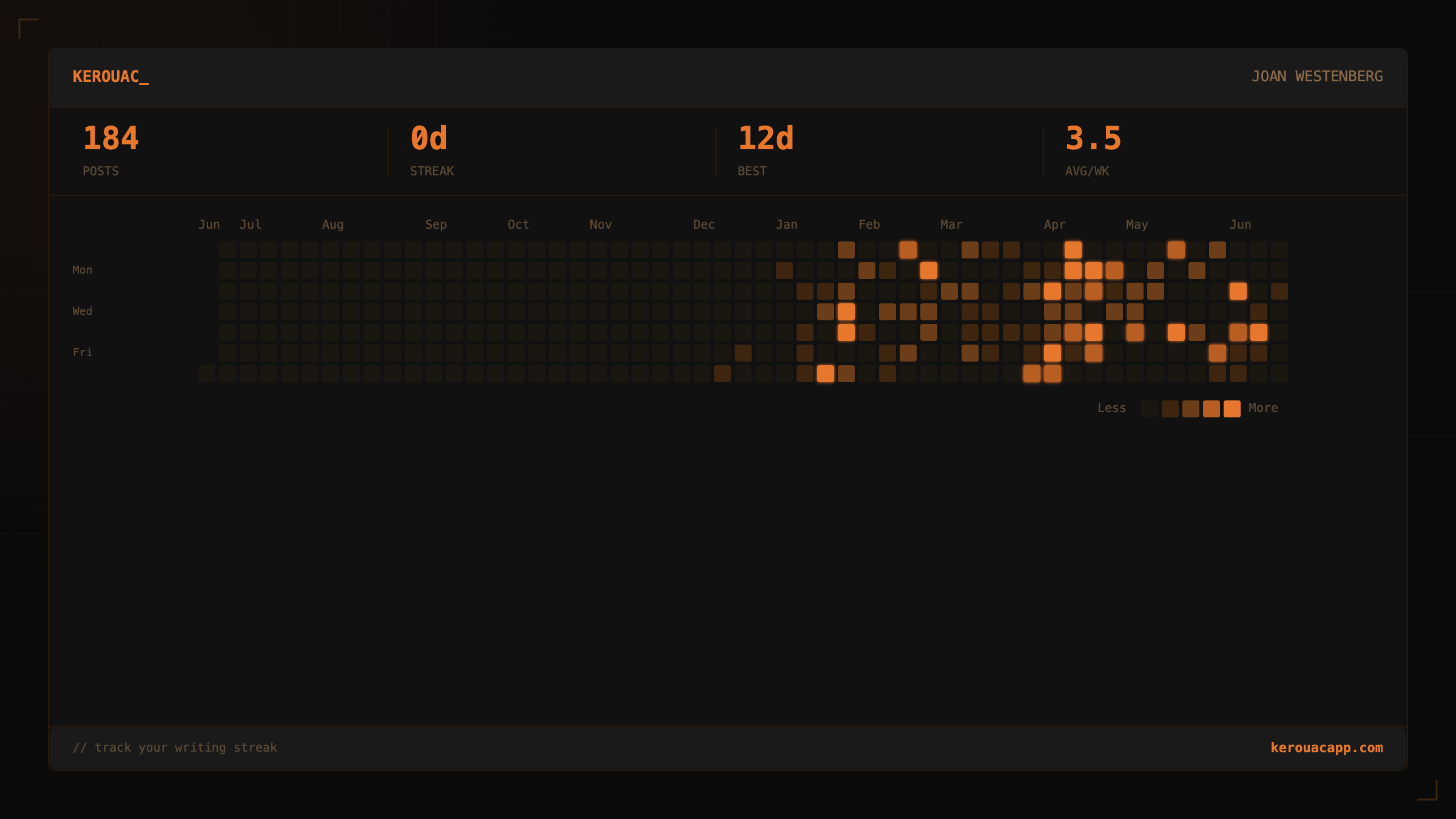
If I thought there was no point in building anything, I’d give up now. But I’ve never been a defeatist, and I don’t see doomerism in my future. If you want to see what I’ve been up to, you can check out my book Permissionless (I’m writing it in public as a Google Doc), and you can sign up for Kerouac, a publishing analytics and commit graph app for writers. You can work with me on your storytelling / GTM / messaging through Studio Self.